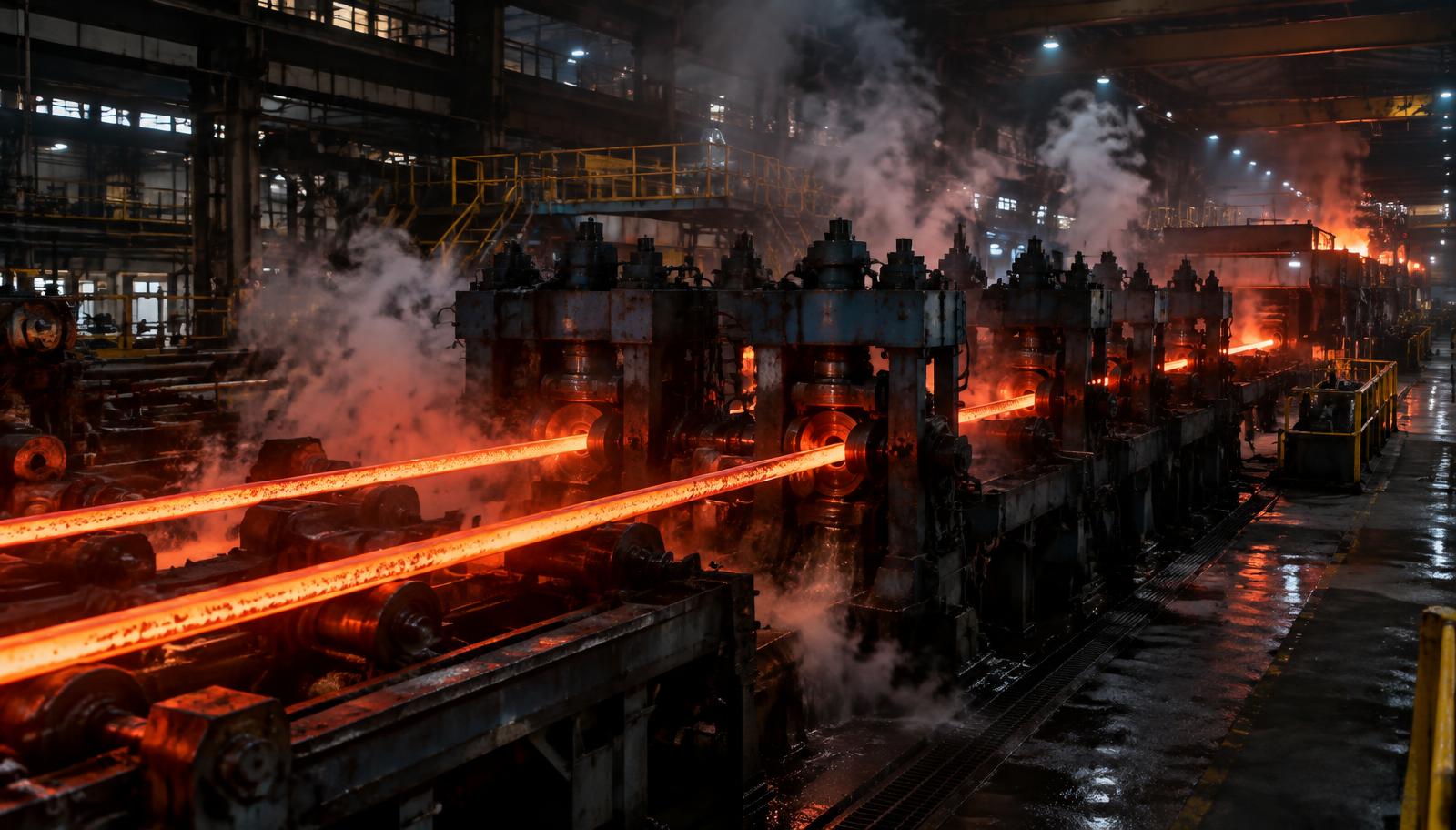
Bearings built for the hottest, dirtiest mills.
Heavy-duty mill bearings that survive heat, scale and water — backed by selection help.
Why it matters on your floor.
TMT rebar and wire-rod re-rolling mills run hot, dusty and non-stop — the toughest environment for bearings. We specialise in heavy-duty mill bearings that survive it, backed by selection help, plus consumables, safety and AI-based rebar inspection.
Products we source and supply for this industry.
Rolling-mill & wire-rod bearings
- Roll-neck bearings
- Four-row tapered roller
- Spherical roller
- Cylindrical roller
- High-speed wire-rod-mill grades
- Continuous-casting grades
- For stands, gearboxes & the cooling bed
Consumables & wear parts
- Shear blades
- Spacers
- Rods
- General mill consumables
Safety
- Heat / flame-resistant PPE (Udyogi range) for hot-mill operators
Also from our other divisions
- Gearboxes, shaft-mounted mill drives and planetary drives
- Cast-nylon guides, rollers and wear pads made to drawing
- Thermal imaging cameras for bearing, gearbox and motor checks
Inspect 100%, automatically.
Send us a video of your cooling bed or bundles and we'll assess feasibility.
Book a free feasibility assessment- Automatic bar counting at the cooling bed
- Bundle counting
- Diameter & rib-geometry measurement
- Surface crack / defect detection
- Cut-length verification
How to choose (and extend the life of) a rolling-mill bearing
Selection starts with three questions: what load, what speed, what temperature? Get those right and most premature failures disappear.
- 01
Load
Roll-neck positions see very high radial and axial loads — four-row tapered or four-row cylindrical bearings are typical. Check the dynamic and static ratings with a safety margin.
- 02
Speed
Finishing and wire-rod blocks run very fast; choose high-speed grades with suitable cages and lubrication.
- 03
Temperature
Heat from the stock affects clearance and lubricant life. Consider increased internal clearance (C3/C4) and heat-stabilised steel.
- 04
Failure modes
Fatigue (spalling), contamination by scale and water, misalignment, and poor or wrong lubrication cause most failures.
Practical steps to extend bearing life
- Keep seals and chocks in good condition to stop water & scale
- Use the right grease and re-lubricate on schedule
- Mount with correct tools and fits — no hammering
- Check alignment at every roll change
- Track temperature with a thermal camera
- Record failures and inspect damaged bearings for root cause
Common questions.
Which bearing is used on roll necks?+
Four-row tapered roller bearings are the most common choice for roll necks; four-row cylindrical bearings are also used with separate thrust bearings.
Why do our bearings fail early?+
Most early failures are caused by contamination (water and scale), poor lubrication or misalignment rather than the bearing itself. We can help review failed bearings.
Do you supply wire-rod-mill bearings?+
Yes, including high-speed grades for wire-rod blocks and continuous-casting grades.
Can AI vision count bars at the cooling bed?+
Yes — automatic bar and bundle counting is one of the most proven machine-vision applications in rebar mills.
Do you supply heat-resistant PPE?+
Yes, flame- and heat-resistant gloves, aprons, face shields and workwear from the Udyogi range.
Guides for your team.
- Rebar
How to Choose a Rolling-Mill Bearing — and Make It Last
Load, speed and temperature decide bearing choice. Contamination and lubrication decide how long it lasts.
- AI Vision
Counting & Inspecting Rebar with Machine Vision
Automatic bar counting, bundle checks and rib measurement — where cameras beat manual counting.
- Power Transmission
Choosing a Planetary Gearbox or Slew Drive for Heavy Duty
Torque, ratio, service factor and mounting — the essentials for specifying heavy-duty drives.
Tell us about your rebar & steel operation.
Share part numbers, drawings, photos or the problem you want to solve.